I’ve recently created half a dozen songs using ChatGPT and Suno. Some are genuinely good — at least to my ears — and each took roughly 30 minutes.
I’m not starting from zero musically. I play guitar at a level just below intermediate, dabble on piano and have written a few songs on guitar over the years, although they’re rudimentary at best. AI has allowed me to turn ideas into polished-sounding tracks that would previously have been well beyond my recording and production abilities.
And that got me wondering what happens when everyone can do the same.
The flood has already begun
According to Fortune, Suno was generating around 7 million songs a day in mid-2026. Those are generations, not commercial releases: many will be discarded versions, private experiments or works in progress.
But even the number reaching streaming services is remarkable. Deezer reported that fully AI-generated uploads rose from about 10,000 a day in January 2025 to 90,000 in June 2026. At their peak, they exceeded half of all daily new deliveries.
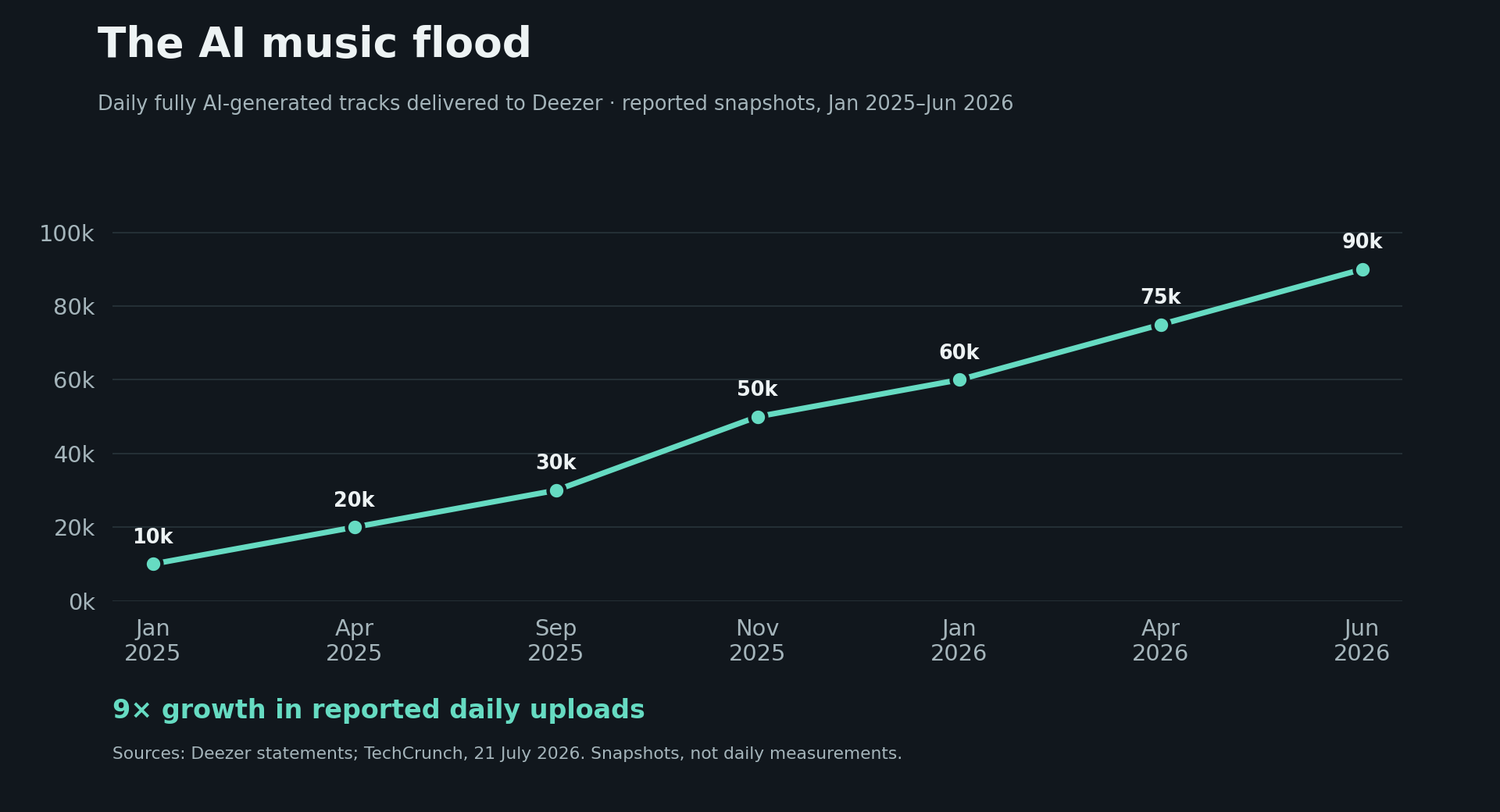
Read chart 1 data as a table
| Reported snapshot | Daily fully AI-generated tracks |
|---|---|
| January 2025 | 10,000 |
| April 2025 | 20,000 |
| September 2025 | 30,000 |
| November 2025 | 50,000 |
| January 2026 | 60,000 |
| April 2026 | 75,000 |
| June 2026 | 90,000 |
By August 2026, Deezer had identified and excluded more than 42 million AI-generated tracks from recommendations. That doesn’t mean all those tracks were removed from its catalogue. Nor should we confuse the number of songs generated with the number published or actually heard.
Who gets heard?
According to Luminate, streaming services already held around 253 million tracks at the end of 2025. Of those, 120.5 million received fewer than ten streams during the year. Around 88% received fewer than 1,000.
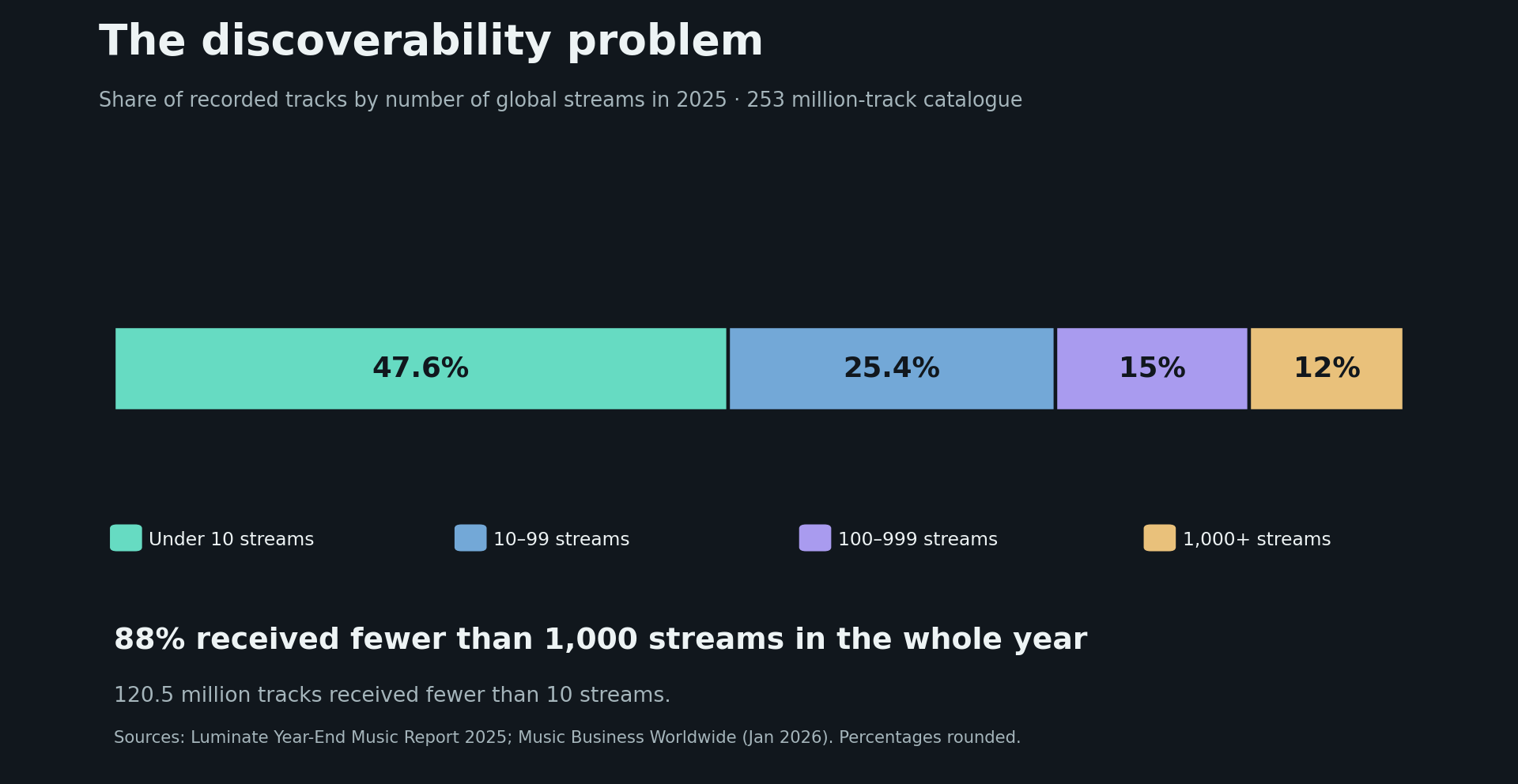
Read chart 2 data as a table
| Streams during 2025 | Share of tracks |
|---|---|
| Fewer than 10 | 47.6% |
| 10–99 | 25.4% |
| 100–999 | 15% |
| 1,000 or more | 12% |
In the same report, just 541,000 tracks in the one-million-to-50-million-stream bracket accounted for nearly half of all global audio streaming. Music distribution was staggeringly unequal before AI accelerated supply.
So discoverability becomes harder. But there's a trap in framing the problem as identifying the “best” songs. Everybody's taste is different. The more interesting challenge is connecting music with people who might love it — including sounds they’d never have thought to seek out.
Do listeners care whether it's AI?
A Deezer/Ipsos study of 9,000 people across eight countries found that 97% couldn't reliably distinguish the AI-generated songs from the human-made song in a limited three-track blind test. Yet 80% wanted fully AI-generated music clearly labelled.
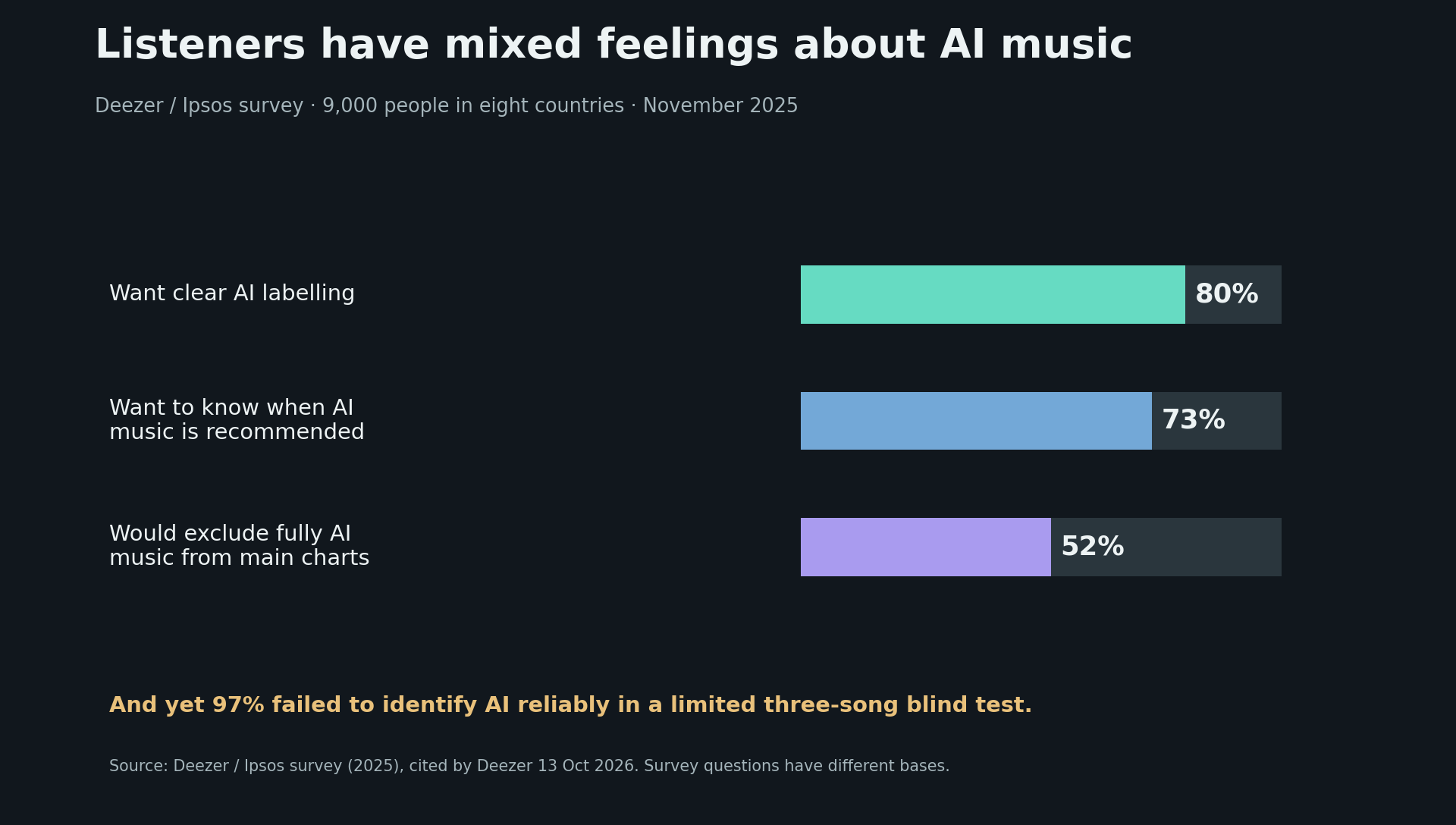
Read chart 3 data as a table
| Response | Share of respondents |
|---|---|
| Clearly label fully AI-generated music | 80% |
| Know when AI-generated music is recommended | 73% |
| Exclude fully AI-generated music from main charts | 52% |
That’s an intriguing tension: we may struggle to hear the difference, while still caring intensely about how music was made. Deezer says fully AI-generated tracks represent only 1–3% of streams on its service, but it also excludes them from editorial and algorithmic recommendations. Those figures are not a clean referendum on listener demand.
The economics could change
The recorded-music industry is hardly collapsing. IFPI reports that worldwide recorded-music revenue reached US$31.7 billion in 2025; streaming generated 69.6% of that, with 837 million users of paid subscription accounts.
But why should streaming services remain mere libraries? They could become personalised listening and music-creation platforms, combining existing catalogues with AI recommendations, remixes and freshly generated tracks.
For human artists, recordings may increasingly serve to attract audiences to gigs, merchandise and direct fan relationships. I'm inclined to think live performance will become more commercially important, but it is no guaranteed safety net. The Music Venue Trust reports that 53% of UK grassroots venues made no profit in 2025, with average profit margins of just 2.5%.
And professional musicians will use AI themselves: generating possibilities, transcribing interesting ideas, reshaping arrangements and recording the results with their own instruments and performers. The line between conventional and AI-assisted composition will become increasingly blurred.
Meet FunkBot, your next favourite artist
Here's the more provocative prospect. Imagine a genuinely autonomous AI artist, FunkBot, composing and releasing a new track every day. It learns from its audience, develops a recognisable sound and personality, and builds millions of followers. What if almost every release is a hit?
We already care about fictional characters. Why not a synthetic musical personality? Perhaps FunkBot eventually releases compositions rather than fixed recordings: you hear a soulful house interpretation while someone else hears indie rock. Same song, different personalised performances.
Of course, an AI trained to maximise engagement could also become a relentlessly efficient manufacturer of the familiar. Popularity and originality aren't the same thing.
What becomes valuable?
AI is removing much of the time, expense and technical skill required to produce professional-sounding recordings. That doesn't make human musicians irrelevant. It does mean that technical polish alone is becoming less distinctive.
Creative identity, individual taste, memorable performances, relationships with audiences and the ability to discover something unexpected may matter more than ever.
Perhaps the biggest question isn't whether AI can make music as good as humans. It's whether, in a world of effectively infinite music, we'll still seek out what surprises us — or settle for hearing exactly what we already know we like.